

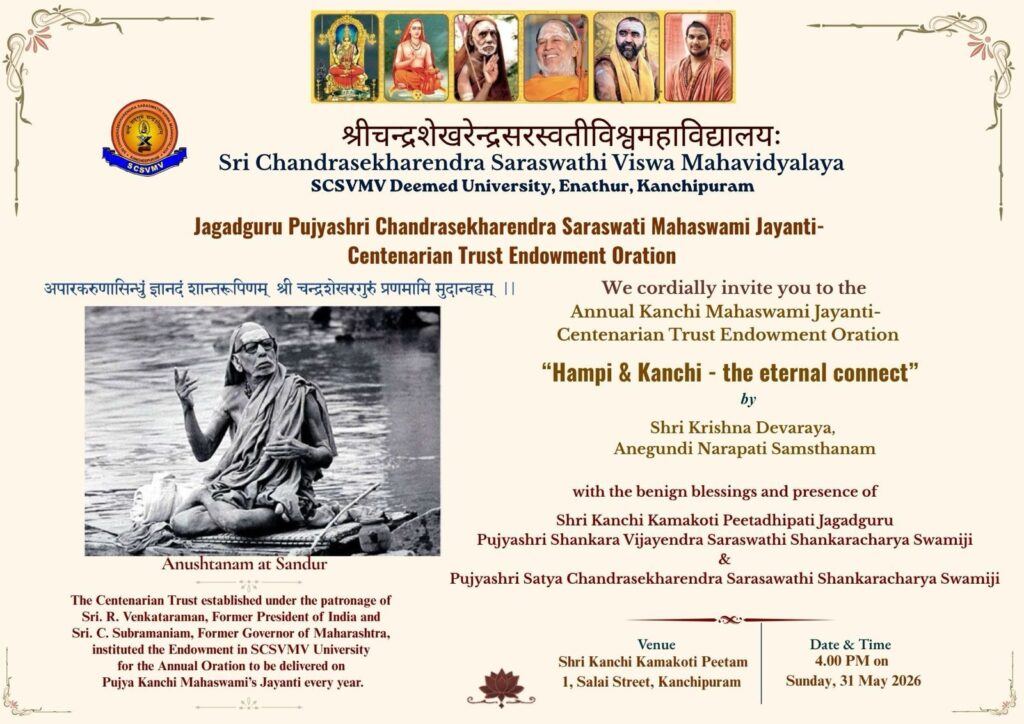
Hampi and Kanchi – The Eternal Connect
With the benign blessings of Sri Sri Vidyaranya Peetha Swamiji, and with reverence to my Gurugaru, Sadguru Sri K. Sivananda Murthy garu,
My humble pranams at the lotus feet of Pujya Shri Shankara Vijayendra Saraswathi Swamiji and Pujyashri Satya Chandrasekharendra Saraswathi Swamiji.
Respected dignitaries, revered devotees, distinguished scholars, beloved students, and dear brothers and sisters gathered here – my humble namaskarams to all of you.
I am blessed to be born in a family who have stood up and have been responsible for the revival of Hinduism in our Country. It is both a privilege and a deeply emotional moment for me to stand before you and speak on a subject that is not merely historical, not merely cultural, but profoundly civilizational — “Hampi and Kanchi: The Eternal Connect.”
If Hampi represented strength, courage, sacrifice, and protection of a civilization, Kanchi represented wisdom, devotion, philosophy, learning, and continuity of this civilization.
If Hampi was the arm of civilization, Kanchi was its heart.
And what happens when strength walks without wisdom? It becomes domination.
What happens when wisdom exists without protection? It becomes vulnerable.
Civilization flourishes only when the two walk together.
And that, in many ways, is the story of Hampi and Kanchi.
It is the story of शास्त्र (Shaastra) & शस्त्र (Shastra) wisdom and power- guided by dharma.
The great genius of Bharatiya civilization was never separation but inclusion.
We never believed political power and spiritual wisdom should exist in isolation.
Our kings sought blessings from rishis. Our warriors bowed before gurus.
Our rulers saw themselves not as owners of kingdoms, but custodians of dharma.
The Vijayanagara rulers exemplified this spirit.
And nowhere is this relationship more beautifully visible than in their deep and enduring bond with Kanchipuram.
To understand this bond, we must briefly travel back into history. The fourteenth century was a difficult period in many parts of India. Political instability had disrupted sacred institutions. Temple ecosystems had suffered. Pilgrimage routes weakened. Many centres of learning lost continuity.
When historians speak of invasions and political turmoil, sometimes we reduce the story to kings and battles.
But ordinary society experiences disruption differently. A temple closes. A festival stops. A priest leaves. Music falls silent. A lamp is extinguished. And with that, confidence quietly disappears from society.
Civilization weakens not only when kingdoms fall. It weakens when sacred rhythm breaks.
Our ancestors understood this deeply.
And therefore, the founding of Vijayanagara in 1336 by Harihara Raya and Bukka Raya was not merely political statecraft. It was a civilizational reconstruction.
It was a declaration that dharma would not merely survive – it would flourish again.
The blessings and guidance of Jagadguru Sri Vidyaranya Swamiji gave philosophical and spiritual legitimacy to this vision.
Even today, when one stands in Hampi and remembers Vidyaranya, one feels that Vijayanagara was never simply an empire. It was a sacred responsibility. A dharmic experiment.
A vision that political power must remain answerable to higher principles.
And from the very beginning, Kanchi occupied a special place in this vision.
Why? Because Kanchi was already ancient when Vijayanagara was born.
Long before empires rose and fell, Kanchi had shone as a sacred centre of knowledge, worship, philosophy, art, architecture, and temple life.
It is one of the sacred Sapta Puris of Bharat. A city sanctified by Sri Kamakshi Devi, Sri Varadaraja Perumal, and Sri Ekambaranatha. A city where multiple traditions coexisted and flourished. A city where Advaita, Vishishtadvaita, Shaiva, Vaishnava, Shakta, and Vedic traditions found sacred expression. Kanchi was not merely a city. It was a civilizational memory made visible. And therefore, when Vijayanagara looked southward, it naturally looked toward Kanchi. Not only for strategy. But for sacred legitimacy.
The decisive moment came through Kumara Kampana, the illustrious son of Bukka Raya.
When Vijayanagara sought to restore stability and dharmic order in Tamil lands, Kanchipuram became the principal centre for this mission. Kanchi became both a strategic headquarters and sacred anchor. From here emerged campaigns that eventually restored order in Srirangam, Madurai, and other sacred kshetras. But here we must pause and reflect.
When we narrate history, there is a temptation to glorify war. Yet our ancestors themselves tell us a more refined story. The great Sanskrit work Madhura Vijayam, composed by Kumara Kampana’s wife Gangadevi, is deeply revealing. Many describe it merely as a court poem celebrating conquest. But when one reads it carefully, one senses something more profound. It is not self-glorification. It is grief. It is memory. It is civilizational pain transformed into hope.
Gangadevi writes not merely about military success. She speaks of temples deprived of worship. Sacred spaces interrupted. Societies longing for continuity. In one moving passage, the land itself seems to cry out for restoration. What a powerful idea this is. A civilization grieving not simply for territory – but for loss of sacred rhythm.
And here I would like to pause and say something especially to the young students present. Sometimes young people ask: “Why are temples so important?” “Why should we care about old stones?” The answer is simple. Temples matter not because stone matters. Temples matter because life happens around them. A temple is where a grandmother teaches devotion to a child. Where festivals create community. Where music, dance, sculpture, literature, and philosophy flourish. Where generosity is practised. Where emotional resilience is built. A lamp lit in a temple lights confidence in society. The sound of a temple bell reminds people that civilization still breathes. Daily worship, nitya puja, gives emotional and spiritual rhythm to communities. And therefore, when Vijayanagara rulers restored temples, they were not merely repairing buildings. They were healing civilization. This understanding is reflected not merely in poetry but in inscriptions.
One inscription associated with Kumara Kampana’s southern expedition tells us that temples were restored and worship revived “as of old.” Please reflect on those words: “As of old.” or Purvamaryada Not reinvented. Not replaced. Not appropriated. Restored. That reveals humility. The mission was continuity. To restore sacred life so communities could once again flourish. And this spirit becomes one of the defining ideals of Vijayanagara.
Victory was meaningful only when followed by restoration. Power found purpose only in service. Kingship found legitimacy only in dharma. And Kanchi stood at the centre of this sacred vision.
For Vijayanagara rulers, Kanchi was not a distant territory. It was spiritual inheritance. It was blessing. It was guidance. It was home to gurus, acharyas, philosophers, and sacred institutions that nourished the empire intellectually and spiritually. If Hampi protected civilization externally, Kanchi strengthened it internally. One guarded the body. The other nourished the soul. And perhaps this is why, even centuries later, the relationship still feels alive.
Standing in Kanchi today, I feel like someone returning to a sacred relationship that history itself preserved. In many ways, my own presence here feels symbolic. A small bridge between Hampi and Kanchi. A reminder that sacred relationships may weaken with time — but they never truly disappear. They wait. Like the silent stones of Hampi. Waiting for footsteps. Waiting for lamps. Waiting for remembrance.
When we speak of the relationship between Hampi and Kanchi, we must understand something very important. This bond was not symbolic alone. It was lived. It was institutional. It was spiritual.
And above all, it was practical. For the Vijayanagara rulers, devotion was not confined to private prayer. It expressed itself through responsibility. Temples were not treated as monuments to be admired from a distance. They were treated as living centres of civilization – institutions that nourished society spiritually, economically, intellectually, and emotionally.
A temple in our civilization was never merely a structure. It was a university. A theatre. A granary. A social welfare centre. A treasury of art. A centre of music and philosophy. A sacred ecosystem. And therefore, restoring temples after disruption became one of the great civilizational missions of Vijayanagara.
Kanchipuram was already one of the greatest sacred centres in Bharat.
The great temples of Sri Varadaraja Perumal, Sri Ekambaranatha, and Sri Kamakshi Amman had shaped the spiritual imagination of generations. For Vijayanagara rulers, patronage of Kanchi temples was not a political display. It was an offering. It was gratitude. It was surrender before dharma.
Let us take the example of Sri Varadaraja Perumal Temple.
When one walks through its sacred precincts today, one is walking through layers of history. Among those layers stands the unmistakable imprint of Vijayanagara. Hundreds of inscriptions in the temple testify to sustained patronage. Villages were granted. Jewels donated. Land endowed. Resources allocated for worship, festivals, temple maintenance, and feeding of devotees.
But I want us to look beyond the material aspect. Why would emperors repeatedly invest so deeply in temples? Because they understood something modern society often forgets: Civilization is sustained not by wealth alone, but by sacred continuity. A prosperous kingdom without spiritual grounding becomes fragile. A civilization survives when its people remain emotionally rooted. And temples provide those roots. Among the Vijayanagara emperors, few embody this sacred relationship more beautifully than Sri Krishnadevaraya. We often remember Krishnadevaraya for military achievements, administrative brilliance, literary patronage, and imperial grandeur. All of that is true. But perhaps the deepest measure of greatness lies elsewhere. Great kings know when to bow. Krishnadevaraya bowed before dharma. He bowed before acharyas. He bowed before sacred institutions.
One of the most moving examples survives through a copper plate grant issued during the later period of his reign. In this grant, dated to the auspicious Vaishakha Purnima of 1529, he donates the village of Udayambakkam in Chengalpattu district, renaming it Krishnarayapuram, and offers it to Sadasiva Sarasvati associated with the Kanchi Kamakoti tradition.
Pause for a moment and think about this. An emperor at the height of power gifting not land to generals or courtiers — but to spiritual continuity.
And what language does the grant use to praise the Acharya? Not wealth. Not influence. Not political power. Instead, the Acharya is celebrated as a Paramahamsa Parivrajakacharya, one immersed in yoga, marked by renunciation, compassion, vairagya, wisdom, and radiant spiritual splendour.
In essence, the message is this: The empire bows before spiritual greatness. Kingship finds fulfillment in humility. And Krishnadevaraya’s devotion did not end there. For the spiritual merit of his parents, he gilded the sacred Punyakoti Vimana of Sri Varadaraja Perumal.
Think about the tenderness of this act. Even the mightiest emperor remains a son. He remembers his parents through devotion. He expresses gratitude through sacred service.
This was later renovated by Lakshmi Kumara Tatacharya who also gilded Kalyana Koti vimana of Lakshmi and renovated Kamakoti as well.
Sadly, history also teaches painful lessons. Many sacred embellishments suffered damage or plunder in later invasions. Yet even here we must pause. Civilization survives not because destruction never happens. It survives because restoration continues. That is the story of Bharat. That is the story of Hampi. That is the story of Kanchi.
And the relationship deepened further under Achyuta Devaraya. Achyuta Raya’s devotion to Sri Varadaraja Perumal was profound. Inscriptions record grand acts of offering and patronage.
One especially remarkable example is the mukta tulabharam — the offering of pearls equivalent to the king’s own weight. Today, we hear of such acts and may think only of grandeur. But spiritually, tulabharam is a statement of surrender. It says: “Nothing truly belongs to me.” “Even kingship is held in trust.”
Achyuta Raya also established tulabhara mandapams and gifted ornaments to the deity — sacred emblems including tirunamam, chakra, shankha, and abhaya hastam, many of which continue to remain connected with temple ritual traditions.
How extraordinary this continuity is. Centuries pass. Empires vanish. But rituals remain. Hands change. The offering continues. The deity still receives worship. And in this continuity, civilization quietly survives.
The Vijayanagara rulers also understood something important – dharma thrives through inclusiveness. Their patronage extended not to one tradition alone.
Kamakshi, Varadaraja, Ekambaranatha — Shakta, Vaishnava, Shaiva traditions – all flourished.
And in this spirit, another important relationship emerged — the Tatacharyas.
For generations, distinguished Tatacharya scholars served as rajagurus and advisors to Vijayanagara rulers.
Their association with Kanchi and Sri Varadaraja became an important intellectual and spiritual bridge between court and temple. But again, what is remarkable is balance. They contributed not only to one institution. We see contributions across traditions, temple renovations, mandapas, sacred infrastructure, and broader dharmic life.
This is important for us to remember today. Civilization flourishes when wisdom connects rather than divides.
There is another beautiful aspect of this connection — devotion flowing northward into Hampi.
In Hampi itself, near the Achyuta Raya Temple complex, sacred iconographic representations remind us of Kanchi’s influence. One encounters forms evocative of Sri Varadaraja and Sri Ranganatha. Why does this matter? Because it tells us something profound.
Kanchi was not forgotten in Vijayanagara. Kanchi travelled with Vijayanagara. Its sacred memory entered imperial imagination. Its deities entered devotional life. Its philosophy entered governance. Its blessings entered kingship. And kings understood that devotion alone was not enough. Protection too was necessary.
Civilization survives when wisdom is protected.
At moments of danger, Vijayanagara rulers acted decisively to safeguard sacred institutions. Aliya Rama Raya, often remembered primarily through political history, also played a role in protecting important kshetras like Tirupati and Kanchi from threats and raids.
We may debate historical details, but one larger truth stands clear:
The rulers of Vijayanagara believed that sacred institutions deserved protection.
And here I often ask myself a personal question. As someone born into the lineage of the Vijayanagara Kings – what exactly did our ancestors seek to preserve? Was it merely territory? Was it power? Was it prestige? Or was it something greater?
I increasingly feel the answer lies in continuity. The continuity of prayer. The continuity of festivals. The continuity of guru parampara. The continuity of sacred confidence.
Until now, I have spoken about inscriptions, emperors, temples, copper plates, and historical memory. But if I may say so with humility – the bond between Hampi and Kanchi is not preserved only in stone. It is preserved in grace. It survives in lived experience. It survives in blessings received. For my family, this sacred relationship ceased to be merely history when it entered our lives through the compassion of Maha Periyava, Pujya Sri Chandrasekharendra Saraswati Mahaswamigal. In our family, Maha Periyava was never spoken of as a distant saint. He was spoken of with affection, reverence, intimacy – almost like an elder watching over us.
And perhaps that is why, when I think of Kanchi, I do not think only of philosophy or institutions. I think of compassion. I think of presence. I think of a civilization still breathing through realized beings.
The very first darshan of Maha Periyava that our family had was near Hagari, close to Ballari, sometime around 1978 or 1979. My parents had gone there along with a dear family friend, Ilyi Guruprasad. I had called Guruprasad Uncle a few days back to confirm details of that visit.
The moment I mentioned Maha Periyava, his voice changed. What began as a simple verification turned into a deeply emotional conversation lasting almost half an hour.
He narrated incident after incident of grace. How Maha Periyava protected his family. How his wife found strength during illness. How impossible situations somehow transformed.
And as I listened, I realised something profound. Great saints never truly leave. Their physical form may disappear. But their protection remains active in the lives of devotees.
That very first meeting with Maha Periyava left a lasting impression on our family.
Maha Periyava was pleased to meet my father and asked him a question — simple on the surface, but deeply meaningful. He asked: “The Vijayanagara kings used to conclude their letters with ‘Jai Virupaksha.’ Do you still follow that tradition?” My father humbly admitted: “No, Periyava, I did not know.” And then something beautiful happened. Without command. Without criticism. Without instruction. Through one simple question, Maha Periyava quietly reconnected a family to its own memory. From that very day, my father began writing: Jai Virupaksha.
Think about the greatness hidden in such moments. This is what true gurus do. They restore continuity. Not by force. But through remembrance. Not by making us something new. But by helping us remember who we already are.
And is this not also the story of Vijayanagara? A civilization reconnecting to sacred memory?
In many ways, Maha Periyava himself embodied that civilizational continuity.
He not only carried scriptural brilliance, but also extraordinary cultural memory. He knew places, rivers, forgotten practices, genealogies, temple traditions, local histories — often in astonishing detail.
My parents were fortunate to receive Maha Periyava’s darshan several times — in Hospet, Sandur, Hampi, and even in Anegundi. One Deepavali, Maha Periyava camped for three days at Chintamani Matha in Anegundi. He was sitting near the Narasimha idol and we performed the padapuja. After that Pujyashri Jayendra Saraswati Swamiji visited our home. As soon as he entered, he quietly walked into the puja room. He stood silently for a few moments. Then he turned to my father and said: “Bring me a torch.” My father wondered what Swamiji intended. Swamiji pointed the torch upward toward the ceiling and revealed the ancient navagraha mandala there. Then he said something unforgettable: “I could feel the vibrations of this from outside.” What sensitivity must such realized souls possess? How refined must perception become when spirituality matures? For most of us, sanctity is visible. For great beings, sanctity becomes tangible. They do not merely see divinity. They experience it.
And perhaps these incidents remind us of something important: Civilization survives not merely through architecture. But through awakened beings who know how to recognise sacredness.
Among all the memories my family treasures, one story has especially stayed with me because it carries within it a lesson for our times.
At one point, Maha Periyava instructed my father to begin nitya puja at the Badavilinga in Hampi. Imagine that for a moment. Today, thousands visit Hampi as tourists. They admire ruins. Take photographs. Speak of architecture. But Maha Periyava looked at Hampi differently. He saw living sanctity. He saw waiting deities. He saw interrupted worship. He saw continuity asking to be restored.Maha Periyava told my father something beautifully simple.
He said every household should contribute one mushti of rice – one handful of rice every day – and this should sustain the pujari performing worship. My father hesitated. He felt shy. He wondered: “How can I go door to door asking people?” And then came Maha Periyava’s response – practical, compassionate, deeply profound. He said: “During elections, Indira Gandhi goes house to house asking for votes. You go house to house asking for one mushti rice for Badavilinga.”
What extraordinary wisdom. No grand fundraising. No institutional complexity. No speeches. No bureaucracy. Just one handful of rice. One family at a time. One act of participation. One act of devotion. And today, more than forty years later, that tradition continues.
Think about what this means. A movement of restoration sustained not by wealth – but by faith. Not by power – but by participation. Not by abundance – but by sincerity. And perhaps, dear devotees, this story contains the blueprint for the revival of Hampi itself.
People sometimes ask: “How can Hampi ever return to greatness?” “How can we revive such a vast sacred landscape?” My answer is simple. We begin where our ancestors began. With worship. With responsibility. With continuity. Not everything must happen in one day. Civilization is rebuilt gradually. Lamp by lamp. Temple by temple. Prayer by prayer. The stones of Hampi are not asking us for sympathy. They are asking us for participation.
When I walk through Hampi, I often feel something difficult to describe. The grandeur overwhelms you. But silence also speaks. The mandapas stand. The pillars remain. The sacred geometry survives. Yet somewhere there is waiting. A waiting for bells. A waiting for chants. A waiting for footsteps of devotees. A waiting for lamps to return. And therefore, I say this with humility, devotion, and responsibility:
It is our duty – my duty, your duty, our generation’s duty – to revive Hampi. Not merely as archaeology. Not merely as tourism. But as living civilization. Let us begin with something achievable. Let us restart and strengthen nitya puja across Hampi’s temples. Let us revive ritual continuity. And perhaps, symbolically and spiritually, let us begin with the Hazara Rama Temple — the heart of Vijayanagara’s royal sacred geography.
Why Hazara Rama? Because Rama has been the very soul of Sanatana Dharma civilization in this nation since eons. Whatever be the sampradaya to which a person belongs, the ideal Rajya is always Rama Rajya and Rama the ideal ruler. The Vijayanagara Kings wanted to establish Rama Rajya here so they constructed the Hazara Rama temple at the centre of the city. And Rama Rajya was not merely a political imagination for Vijayanagara. It was ethical aspiration. Rama Rajya means every being receives dignity. Justice prevails. Duty prevails. Temples flourish. Society functions harmoniously. And yes – even deities receive their rightful worship. Because civilization weakens when gods are neglected.
This revival cannot happen through government alone. Nor through one family. Nor through one institution. It requires collective responsibility. We need devotees. We need scholars, archakas, vaidikas, artists, musicians, students, historians, and above all -we need sacred intent.
I dream of a day when there will once again be movement between Kanchi and Hampi. When young Vedic students from Kanchi come to Hampi. When festivals connect our sacred geographies. When scholarship, museum collaborations, manuscript studies, music, ritual traditions, and temple culture create once again an ancient corridor of civilization.
For in truth, this corridor never disappeared. It merely fell silent. And silence too can end.
Standing before you today in Kanchi, I feel this gathering itself symbolizes reunion.
A descendant of Vijayanagara empire speaking in Kanchi. History meeting memory. Protection meeting wisdom. Hampi bowing once again before Kanchi. And Kanchi blessing Hampi. Many say Hampi the city fell in 1565. Politically, perhaps yes. But spiritually? Civilizationally? No. Because dharma survived. Guru parampara survived. Memory survived. But the ideal endured. And therefore, I conclude with a prayer – and a plea.
May we not become a generation that merely photographs civilization. May we become a generation that revives it. May lamps once again glow in neglected sanctums. May bells ring again across Hampi. May nitya puja flourish. May scholars and devotees travel once again between Kanchi and Hampi.
May our children inherit not silence – but sacred continuity. And may the ideals of Rama Rajya – justice, devotion, humility, service, and dharma — guide us again.
For our deities still wait. The stones still remember. History still calls.
The question is only this: Will we answer?
Let me conclude with what my Gurugaru always said “Sarve sujana sukhino bhavantu sarve jana sujana bhavantu” Let all those who are walking on the path of Dharma be happy and content in life and let us all walk on the path of Dharma.
Jai Virupaksha.