

Dr. R. Jayakumar
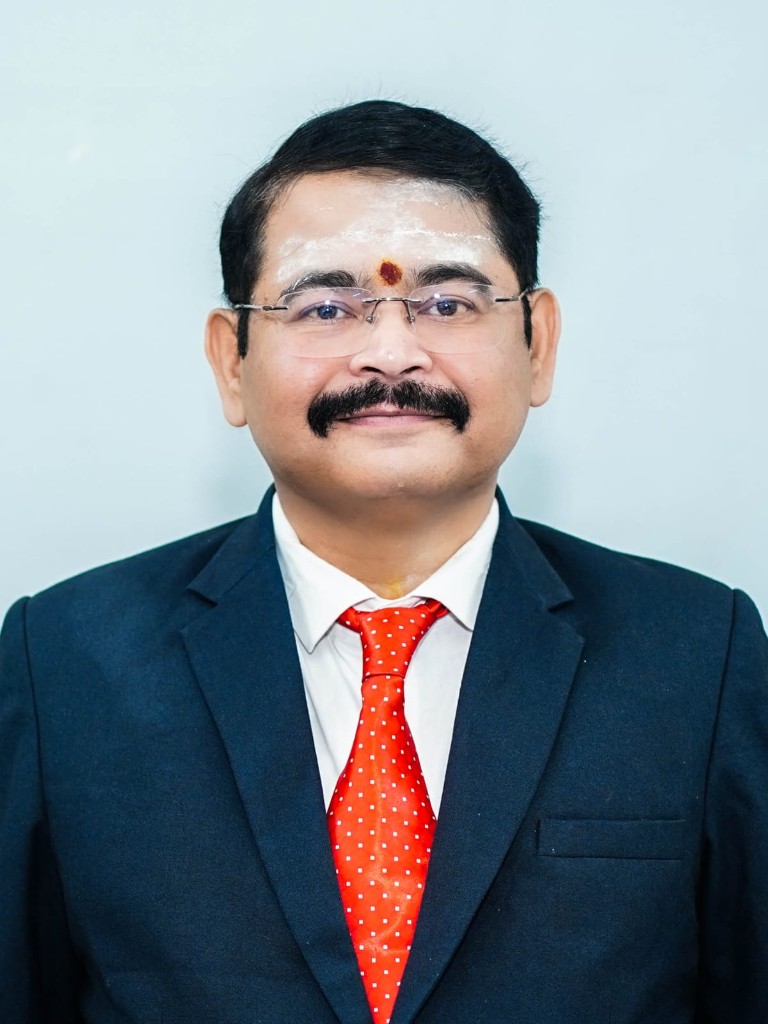
Dr. R. Jayakumar
Professor & Dean – Academic Affairs
Email ID:
rjkumar8@yahoo.com
shirishjayakumar@gmail.com
Mobile No.: +(91) 78299-99957
LinkedIn
ORCID
ResearchGate
Google Scholar
Qualification
B.Sc. Zoology (IIIrd Rank), M.Sc. Environmental Science (IInd Rank with Distinction), M.Phil. Environmental Science, Ph.D. Environmental Science (SACON / MoEF&CC)
Area of Research:
• Ecotoxicology & Environmental Contaminants
• Heavy Metal Biomarkers in Birds & Fishes
• E-waste Toxicity & Metal Recovery
• Climate Change, Wetlands & Wildlife Toxicology
• Solid Waste Management & Sustainable Practices
Professional Experience: 24 Years
Teaching Experience: 18 Years
Research Experience: 20 Years
Scholarly Profiles:
• LinkedIn: jayakumar-rajamani
• ORCID: 0000-0003-0861-224X
• Scopus ID: 56604068100
• ResearchGate: Rajamani_Jayakumar
Academic Awards / Honours:
1. Secured IIIrd Rank in B.Sc. Zoology; IInd Rank in M.Sc. Environmental Sciences.
2. Awarded second rank for project presentation at Tamil Nadu State Council for Science and Technology, Chennai.
3. Received CSIR–UGC SRF fellowship (2 years).
4. Best Researcher Award – 2017, GITAM University, Bengaluru Campus (from Dr. Sowmya Swaminathan, Director, WHO Geneva).
5. Award of merit on National Recycling Day from ITC for disposing 1.5 tonnes of solid waste (GITAM University, Hyderabad).
6. Biotechnology Research Excellence Award from BRSI & SLSI (24 November 2023, AKS University, Satna, MP).
Selected Resource Person / Keynote engagements:
1. Keynote speaker – Genotoxicomics of E-waste on Annelids, AI-BSBB2023, AKS University, Satna (22–25 November 2023).
2. Keynote speaker – Wetland Day Celebrations, Mahasamund Forest Division (2 February 2024).
3. Panelist – Chhattisgarh Climate Change Conclave 2024, Dept. of Forests and Climate Change, Govt. of Chhattisgarh.
4. Chairperson – Indo-US Conference CliCON OEH2025, ICMR-NIOH, Ahmedabad (26–28 February 2025).
5. Resource person – E-waste Management: Handling and Challenges, AICTE ATAL VAANI National Seminar, Kalinga University (3–5 September 2025).
6. Multiple invited lectures on AAS, biomarkers in ecotoxicology, research proposal design, disaster management, and environmental awareness at SACON, ICMR-ROHC, Auxilium College, and other institutions.
Subjects Taught:
• Environmental Studies / Environmental Science
• Environmental Engineering I & II (Theory and Practical)
• Sanitation Engineering and Public Health
• Environment and Ecology; Climate Change and Toxicology
• Wildlife Forensic Toxicology; Environmental Science and Toxicology
• Disaster Management; Life Sciences for Engineers
• Research Methodology; Research Writing Skills
• Research Ethics and Publications (Pre-Ph.D. coursework)
• Research Methodology and IPR; Research Project Development and Grant Writing
• Quantitative Analysis (Statistics); Business Research Methods
• Power Environment Interface; SPSS Statistical Software
• Environmental Impact Assessment; Global Environmental Concerns; Environmental Auditing
SWAYAM PRABHA / NPTEL contributions:
• Created “Environmental Studies” video lectures (13+ hours) broadcast on SWAYAM PRABHA (CH-15).
• Crafting MOOC on Climate Variations, Adaptations and Strategies (NPTEL SWAYAM – 3 credits, 12 weeks).
JOURNAL PUBLICATIONS – SELECTED (SCOPUS / INTERNATIONAL)
Muralidharan S, R Jayakumar and G Vishnu, “Heavy Metals in Feathers of Six Species of Birds in the District Nilgiris, India”, Bulletin of Environmental Contamination and Toxicology 73(2) 285–291, 2004. DOI: 10.1007/s00128-004-0425-x
Muralidharan S, V Dhananjayan, Robert Risebrough, V Prakash, R. Jayakumar and Peter H. Bloom, “Persistent Organochlorine Pesticide Residues in Tissues and Eggs of White-Backed Vulture, Gyps bengalensis from different locations in India”, Bulletin of Environmental Contamination and Toxicology 81:561–565, 2008. DOI: 10.1007/s00128-008-9529-z
Jayakumar R and S Muralidharan, “Metal contamination in select species of Birds in Nilgiris District, Tamil Nadu”, Bulletin of Environmental Contamination and Toxicology vol.87, No.2, pp. 166–170, 2011. DOI: 10.1007/s00128-011-0323-y
Jayakumar Rajamani and Muralidharan Subramanian, “Toxicity Assessment on the Levels of Select Metals in the Critically Endangered Indian White-backed Vulture, Gyps bengalensis, in India”, Bulletin of Environmental Contamination and Toxicology 2015 Jun;94(6):722–6. DOI: 10.1007/s00128-015-1548-y
Wagdevi P, Jayakumar R, Rajaguru P, Muralidharan S, “Atomic Absorption Spectrometer for Assessing the Inorganic Contaminants in Processed E Waste”, International Journal of Recent Technology and Engineering (IJRTE), Volume-8 Issue-5, January 2020; 3639–3643; DOI:10.35940/ijrte.E4819.018520 (SCOPUS)
Dhananjayan Venugopal et al., “Levels and distribution pattern of organochlorine pesticide residues in eggs of 22 terrestrial birds from Tamil Nadu, India”, Environ Sci Pollut Res 27, 39253–39264 (2020). DOI: 10.1007/s11356-020-09978-5
N. Sharmila Devi et al., “Overview of antimicrobial resistance and mechanisms…”, The Microbe Volume 3, 2024, 100083. DOI: 10.1016/j.microb.2024.100083 (Elsevier)
Thangavelu Arumugam et al., “Assessment of agricultural soil quality in macro and micronutrient analysis of Kasargod, Kerala, India, using GIS techniques”, Journal of Hazardous Materials Advances 19 (2025) 100846. DOI: 10.1016/j.hazadv.2025.100846 (Elsevier)
BOOKS / BOOK CHAPTERS – SELECTED
Application of biosurfactant as biosorption… – Green Sustainable Process for Chemical and Environmental Engineering and Science, Elsevier, 2021.
Biomonitoring of pesticide exposure and human health risk assessment using biomarker approach – Pesticides in the Natural Environment, 2022, pp. 563–584.
A Review of the Levels and Distribution Patterns of Organochlorine Pesticides in the Eggs of Wild Birds in India – Issues in Toxicology No. 45, Royal Society of Chemistry, 2023.
Nanopesticides for Targeted Pest and Disease Management – Agricultural Nanotechnology, Royal Society of Chemistry, 2025, pp. 237–263.
Next Generation Biotechnology – Megha C and Jayakumar R, Pothi.com, ISBN: 978-93-342-5373-3.
Waste Management and Sustainable Practices (Bilingual – Tamil & English) – Edited by R. Jayakumar et al., Kalinga University, ISBN: 978-81-970089-5-5.
PATENT
Repurposing magnets from obsolete wired earphones as magnetic concentrator to separate metals from other wastes in domestic environs. Application No. 202421101611 A – The Patent Office Journal No. 04/2025 dt. 24/1/25.
Ph.D. GUIDANCE
Ph.D. Guidance: 1 (Ms. Wagdevi – Awarded)
| Papers Published | Journals (selected listed) | 16+ |
| Book chapters / edited volumes | 14 | |
| Research Projects (Major PI) | DST-SERB / UGC | 2 |
| Research Projects (Minor / Pilot) | CSIR, SACON, APCOST & others | 15+ |
| Ph.D. Guidance | Awarded | 1 |
| Professional Experience | Years | 24 |
| Teaching Experience | Years | 18 |
| Research Experience | Years | 20 |
MAJOR RESEARCH PROJECTS (AS PI):
1. Evaluation of Biochemical responses to Environmental contaminants as biomarkers in the fishes of Andhra Coast – DST SERB (SB/S0/AS/007/2013), 2015–2018 – ₹26,01,000.
2. Assessment of e-waste toxicity on the Earthworm species (Eisenia fetida) – UGC MRP-MAJOR-ENVI-2013-21394, 2015–2018 – ₹16,07,000.
ADDITIONAL RESPONSIBILITIES:
NAAC / IQAC coordination; Centre / Chief Superintendent of examinations; Dean – Academics & Research; Faculty recruitment selection committees; OBE / CO–PO architecture and capacity building; Parent–Teacher meeting committee chair; Enquiry / grievance committees; Outreach – ITC WoW recycling, afforestation, health camps; DST Inspire Science Camp mentorship.